The contemporary conversation around natural wood veneers is no longer
confined to their aesthetic charm; it has evolved into a discourse on material
identity—how veneers perform, adapt, and communicate within increasingly
complex architectural ecosystems. As designers demand deeper alignment between
material behavior and spatial intention, veneers have become a proving ground
for balancing biological irregularity with engineered precision. 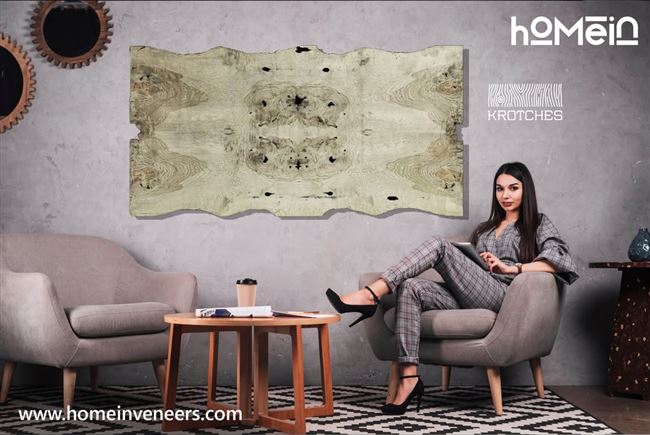
What’s particularly striking today is the emergence of intentional
imperfection as a luxury marker. Instead of chasing visual uniformity,
many studios now curate veneers with mineral streaks, cathedrals, and
unpredictable figure that would’ve once been dismissed as defects. The raw,
unedited narrative of the tree becomes the design asset. In large-scale
installations, these “imperfections” are sequenced with surgical care, creating
gradients of character that unfold across surfaces like topographical maps.
This approach counters the sterile homogeneity often associated with highly
synthetic materials.
Another significant shift involves hybrid fabrication methodologies.
Veneers are increasingly paired with composite substrates engineered for
specific performance metrics—anti-warp stability for ultra-tall doors, acoustic
attenuation for hospitality environments, or micro-perforated backing systems
that integrate HVAC or speaker arrays without compromising the integrity of the
grain. These technical pairings allow veneers to participate in functional
layers far beyond their conventional decorative role.
At the manufacturing level, the veneer industry has entered a new era of data-driven
craftsmanship. Advanced slicing optimization software evaluates every
log for figure consistency, color gradation, and grain trajectory before the
first cut is made. Machine vision now assists in identifying anomalies
invisible to the human eye, allowing more controlled batching and higher
predictability in final installations. Yet, despite this precision, expert
human grading remains irreplaceable—especially for premium species where
tactile intuition and visual sensitivity exceed machine logic.
The sustainability narrative is also maturing. Rather than relying solely on
certification labels, designers are probing deeper into material
stewardship, asking how sawdust is repurposed, how veneer cores are
sourced, and what lifecycle modeling looks like for large-format panel systems.
This adds weight to engineered veneer solutions that replicate exotic species
without accelerating the depletion of rare forests. Ironically, technology is
making “exotic” more accessible while reducing ecological pressure—an
equilibrium once thought impossible.
In forward-thinking interiors, veneers are increasingly employed to mediate
sensory experience. Subtle matte finishes absorb light to create meditative
atmospheres, while high-gloss hand-polished veneers amplify reflectivity for
kinetic, gallery-like environments. Some designers even curate grain rhythm to
influence psychological flow—tight, linear grains that suggest movement in
corridors, or expansive cathedral grains that soften residential volumes.
What truly sets today’s veneer applications apart is the integration
of narrative and engineering. The veneer becomes the dialect between
natural unpredictability and architectural discipline, a calibrated artifact of
both forest and fabrication lab. It is neither purely organic nor overtly
manufactured—it sits in a rare middle space where authenticity meets control.
As architectural expectations continue to escalate, natural wood veneers
will remain invaluable not because they replicate wood, but because they
reinterpret it—revealing, through deliberate craft, the full expressive potential
of nature in constructed space.
For More Related Contents Visit Our
Website:
Website: https://homeinveneers.com Follow Us
On: Whatsapp, Facebook, Instagram, YouTube, LinkedIn, Pinterest
|











.jpg)